|
|
Hello all, I have a 1991 240 wagon that was picked up in Sweden and then shipped over here. Diplomat sales program?? Anyway, the thing has daytime running lights, and I was wondering how to disable them where they will work only when I chose to have them on. I live in Texas and it's annoying to have headlights on when its 104 outside and the sun is shinning bright. I would not want to disable them if I lived in Ontario or something, but down here they are not necessary. Any advice would be welcome :)
Scott In Dallas
|
|
|
|
|
Ok, For anyone who has been tired of driving around in broad daylight with your headlamps, tail-lamps, running lamps, and instrument lights on. I now have the solution to rid yourself and your brick from DRL's. As Art suggested the grey wire going to position number 5 on the headlamp switch will indeed turn off your headlamps. Unfortunately, the running lamps, tail-lamps, and instrument lights will STILL be on. The Headlamp switch itself is bridged in some way. Anyway, I decided to compare the headlamp switch from my 91 with DRL's to a spare switch I had lying about from an 87. As I suspected, the older switch has fewer spades than the newer switch. So, all that one needs to do to get rid of the DRL's is to install an older headlamp switch (pre-DRL's) on your DRL car. Since there are fewer spades on the old switch there is no way for power to get to the Headlamps, Running Lamps, Tail-Lamps and Instrument lamps when the switch is in the OFF position. With the older pre-DRL headlamp switch installed you will now have control of your car again, and can decide for yourself when you want to be lit up. The DRL's should be left for Motorcyclists so they will stand out from the crowd. When I retire and move to Canada I can put my DRL headlamp switch back in and be good to go. Hope this helps someone :)
|
|
|
|
|
My 1998 S90 and 2010 XC60 (both Canada market) are the same as your 240; ALL lights are on all the time when the engine is running. I have found no way to kill them when you are parked for a time with engine running.
On the S90 I bought a USA-spec headlight switch from FCPGroton and this has a little slotted screw at the bottom which you can turn and this kills the always-on feature and puts the driver in charge of whether or not the lights are on.
I don't know what Volvo's logic is with their DRL setup - you are using up the life of nearly every light in the car all the time. Many other mfgr's have a more sensible setup, wherein the car's high beams at 60%-70% power serve as daytime running lights. Many of these will automatically switch on the normal headlights (and all others, plus kill the DRL's) when low ambient light levels require. Absent that feature, we see a lot of inattentive drivers sailing along after dark with DRL's on and no taillights or markers. Totally blacked out from a rear view.
On non-DRL cars I own/used to own, I've rigged up a 2-relay-and-resistor circuit to run the high beams at reduced power as DRL's. This switches off when the parking/tail lights are turned on, or I toggle the little dash switch. Works fine.
--
Bob: Son's XC70, my 83 240, 89 745 (V8) and XC60. Also '77 MGB and some old motorcycles
|
|

|
|

I wonder what that DRL-specific switch was good for? Seriously, before modification, you could not turn off headlights or running lights with the motor running? Must be legislation. Learn something every day.
--
Art Benstein near Baltimore
Police were called to a day care where a three-year-old was resisting a rest.
|
|
|
|
|
Hi Art, always good to hear from you, as you are indeed the oracle of the Volvo world :) In answer to you question, Yes, anytime I turned the key to the RUN (On) position, ALL the lights would be ON. It really made me wonder why they bothered to install a headlamp switch at all, as no matter what position the switch was in, all the lamps were on (Head, running, tail, instrument). Moving the switch from OFF, to the middle position (running lamps), or to ON, made no difference in the intensity either way. It just annoyed me. Living in this miserably hot and bright place you can hardly see the DRL's anyway. It is incredibly Light outside most of the year. I DO always turn my lights on when its is cloudy outside etc. because I am worried about someone not seeing my Brick, but just like I want to shift my own gears, I want to control my lighting. Of course, you are talking to the same person who enjoys double-clutching, setting the spark advance, and hand crank starting my antique vehicles... I bought the car from a Swedish lady who's ex was employed/stationed in the US embassy in Sweden. They bought the car new over there and once his tour was up, they had the car shipped back to the States. She said the US Govt. paid for the shipping or part of it (can't remember exactly) So here it is.... I like it because its a Wagon (I have a sedan as well) and it has a 5 speed gearbox :) I am fixing (about) to replace the torque rods, Panhard rod and coil springs (sagging) on my sedan. I have a "clunk" every now and then. Trailing arm bushings are 2 years old, so all I can guess is it's the torque rod bushings... although they look Ok. Springs are sagging. Anyway wanted your opinion on my clunk, and recommendation for Springs. Maybe I should start a new Thread?
Best Regards,
Scott in Dallas
|
|
|
|
|
Hi Scott,
I'll pass on the spring topic. I've made changes (wagon springs put on a sedan) but not noticed anything worth a hurray.
Reading about the origins of your car, and Derek's response, I'm wondering if I know your car at all. There are other pages in the wiring book addressing dim/dip (reduced intensity United Kingdom) and headlight beam length control I vaguely associate with European market cars.
Does your car have plastic headlights?
--
Art Benstein near Baltimore
If lawyers are disbarred and clergymen defrocked, doesn't it follow that electricians can be delighted, musicians denoted, cowboys deranged, models deposed, tree surgeons debarked, and dry cleaners depressed?
|
|
|
|
|
Hi Art, sorry for the delay in my reply.... I have genuine plastic lenses :)
|
|
|
|
|
You probably have overseas (Swedish) wiring (per your earlier discussion about DRLs), and yet the conventional USA-DOT plastic headlights, because of the certified importer.
When a car made for European standards is imported*, it usually has to undergo certain changes to comply with USA standards of the DOT and EPA. One of these might (almost certainly) have been changing your headlights from the Euroheadlights (that we covet) to the dismal plastics.
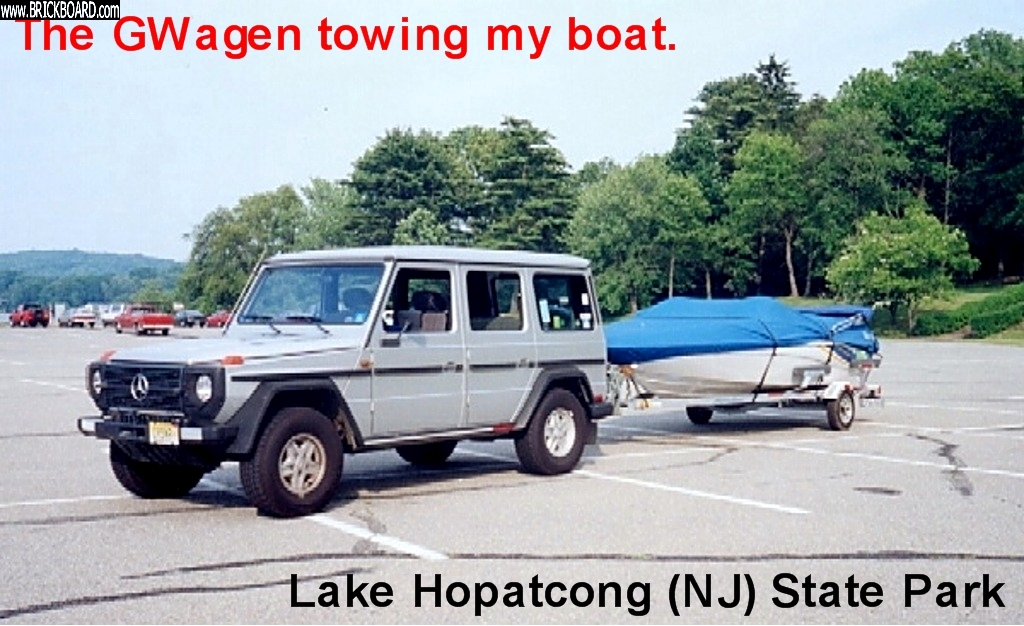
[ * I'm speaking from personal experience. I had a grey-market Mercedes-Benz Gelaendewagen, a 1984 280GE (see my picture below), which as a W460 (1979-1990)was actually a barely civilized military vehicle at that time, rather than the plush W463 "GWagen" version for rich Americans and even richer Russian mafia that Mercedes started selling in 1991 and still sells (but not much longer) here. Since this was long before M-B was selling it in this country, it was a "grey" and had to undergo such conversions by a certified importer before it could be registered in the USA. I needed to keep its documents not only to register it legally in this country but also as a sort of "provenance" so that, when it came time to sell it to someone else, they would be able to reregister it as well. The documents were from the DOT, saying that the car had been converted to comply with safety regs, and from the EPA declaring that the car's emissions met federal standards.]
|
|
|
|
|
I have a '92 SE Wagon here in the UK and that has DRL's. When I first got the car I did several night time runs, some out of town, with just them on, not realising that I actually had no lights switched on. As you say, there is no difference when you switch onto the first position. An easy mistake to make if you don't actually need main beam/dip levels of lighting. Enjoy your cars.
PS I'll have to have a look to see if I have the grey, "Canada wire" that was mentioned.
|
|
|
|
|
re "...For anyone who has been tired of driving around in broad daylight with your headlamps, tail-lamps, running lamps, and instrument lights on *. I now have the solution to rid yourself and your brick from DRL's....."
[ * I agree (and see below) only with your assessment that it is an unnecessary waste to have your taillights and instrument lights on with DRLs, since (1) taillights can be confused with brake lights by less intelligent drivers and don't help with your visibility to them, and (2) instrument lights are of no value in daylight, plus are inconvenient to change when they're burned out.]
USA market 240s don't have the problem you've "suffered" with your overseas car ("...a 1991 240 wagon that was picked up in Sweden and then shipped over here. Diplomat sales program??...").
My two 240's, both USA marketed '93 model year, never had the obligatory DRLs that you speak of (and I'm sure, earlier USA market cars as well).
Yes, you can opt for having DRLs in these cars if you merely leave your headlight switch ON all the time -- then all the lights will shut off when you shut off the engine, protecting the battery from draining down. But it's your choice -- simply use the headlight switch as most ordinarily do, ON when you drive at night, and OFF during the rest of the time, and you're not "bothered" by having any DRL feature.
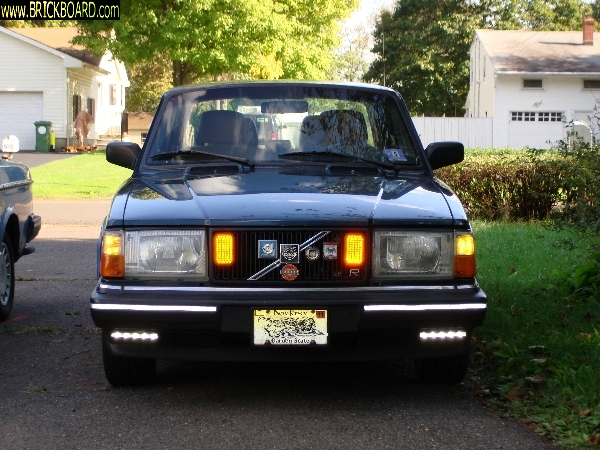
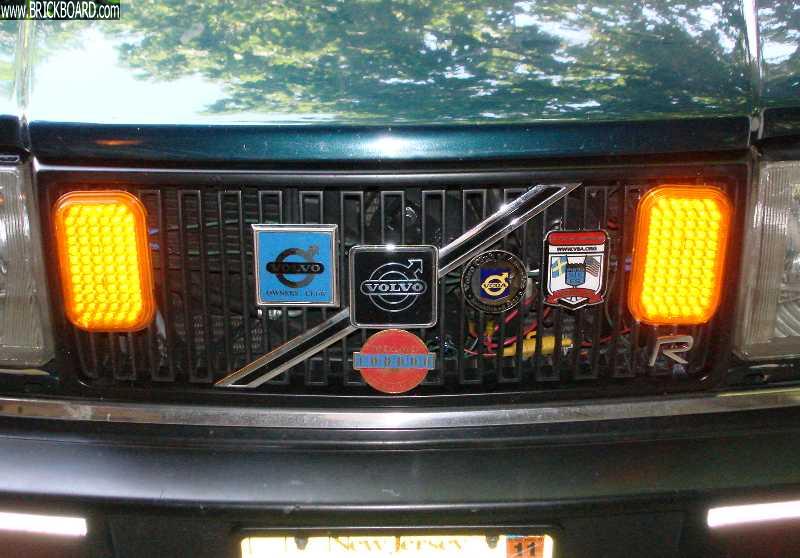
As for myself, and in deference to your feelings* about them (after all, everyone is entitled to their own opinion), I've been a proponent of DRLs (although solely front lamps) for decades (e.g., my article in the Volvo Club of America's magazine on how to incorporate DRLs in an older 240, Rolling Sep/Oct '87, pg 7). Many times I've almost been hit by another car but saved by the last minute by my DRLs (someone changing lanes into my side but finally noticing me in their side mirror and swerving back, or pulling through a stop sign but the halting at the last minute). The function of DRLs is to catch the eye of inattentive motorists, those gliding through stop signs without really looking both ways, changing lanes without checking their mirrors or turning their head, etc. After all, here not everyone is packing a Colt 45, so people tend to be less careful. DRLs may hopefully catch their attention out of the corner of their eye ('gee, what is that?'). But it depends on being "unusual" and therefore attention-getting.
And since most cars have headlight DRLs now (although many European cars use strips of white LEDs now), people have grown used to headlight DRLs and they're no longer as effective, so one has to be more conspicuous than the run-of-the-mill headlight DRL. So I've escalated my DRLs as shown below. But rather than run my H4 halogens in my Cibie/Volvo Euroheadlights, I've added LED lights that I use for DRLs instead, driven by an aftermarket DRL control module.
|
|
|
|
|
Hi Ken, Thanks for the reply :) I agree with all your points, and I really like how you have your machine set up. On my goofy car, the headlamps, running lamps, tail-lamps and instrument lights all would come on by merely turning the ignition switch to the ON (run) position, regardless of the headlamp switch being OFF. Turning the headlamp switch to the Running lamp position, or to the ON position would have no effect on the "already on, headlamps" That is, the intensity would not change one way or the other. The Swedish lady I bought the car from's ex-husband was the ambassador to Sweden (Or in the US embassy in Sweden), don't remember exactly what she told me. She said they bought the car in Sweden and then after her husbands tour was up they brought it back with them to the States. It's a cool car having the 5 speed gearbox etc. The on all the time DRL's is among a couple of weird things local Volvo folks here have spotted as different from US models. I have a slanted view on DRL's. I rode nothing but a motorcycle for many, many years and was not happy when automobiles appeared with DRL's, as I figured ANY edge on being seen, would slowly disappear as motorist became used to seeing them. I still believe this. When only motorcycles had them, motorcycles WERE easier to spot, to me, anyway. I noticed the same phenomenon with my job with the Fire Department here in Dallas. Years ago, when we just went code (Lights and Sirens) to FIres, motorists would yield and move out of the way because it was not a frequent occurrence. Now we make Thousands of EMS calls in addition to Fire calls and they see us SO much going code, no one notices, yields, or gives a hoot. I will concede, that it could just be because our society has degraded to the point that everyone is wrapped up in themselves (Me,ME,ME) and care nothing about the fact someone is in distress, or something is burning to the ground. I digress. I do agree with all your points though... like I said, I just have a different perspective..... Thanks again for the response :)
|
|
|
|
|
Thanks for your kind reply.
As I recall, Sweden was the first country to mandate DRLs -- as I hazily recall (from back in the late '70's or early '80's), they first rationalized it because Sweden, a country at high latitudes (long seasons with little sunlight) and a frosty weather (frequent fog and mist), had long periods of poor visibility in which cars that weren't lit up could not be readily seen. Therefore mandating that lights should be on all the time makes sense.
Canada adopted it later for the same reasons.
Of course, European driver training and standards being what they are, it's no wonder that concern about inattentive or careless drivers wasn't high on their list of reasons. Here, in stark contrast, we have better weather conditions, but worse drivers :-). But DRLs (IMHO) are a help here, for cars as well as motorcycles.
Best regards,
Ken
|
|
|
|
|
Scott,
I'm guessing you need to remove the "Canada wire." It is noted in this drawing:
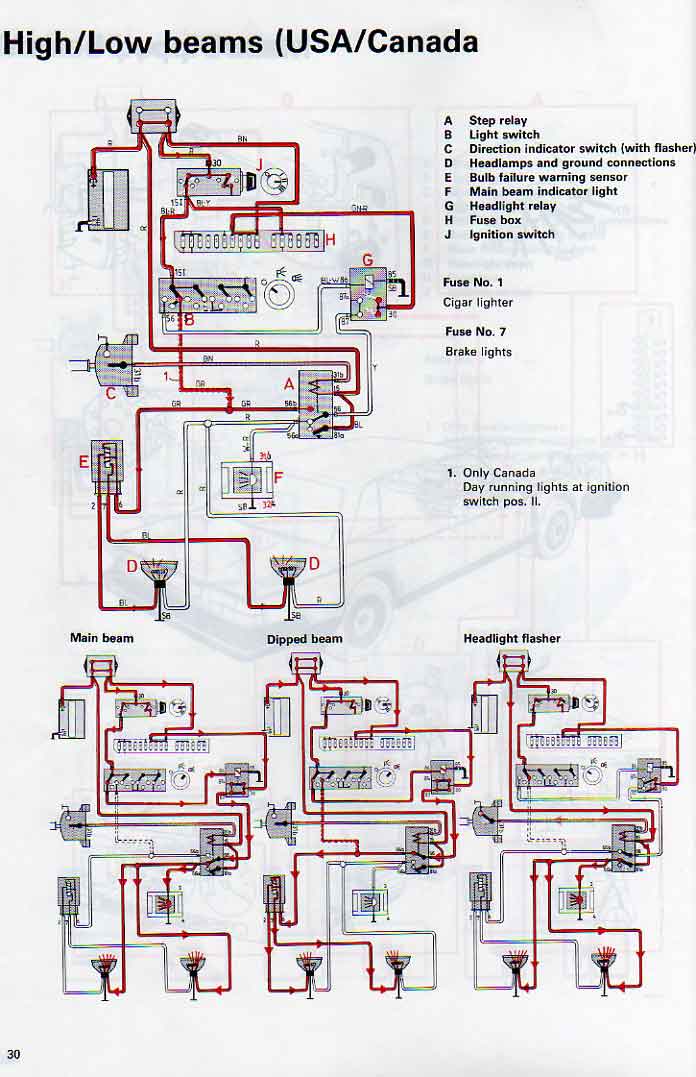
A gray wire on the "S" terminal of the light switch.
--
Art Benstein near Baltimore
“Never underestimate the difficulty of changing false beliefs by facts.” --- Henry Rosovsky
|
|
|
|
|
Thanks Art! I will see if I can find the gray wire on the light switch..... Thanks again :)
Scott in Dallas
|
|
|
|
|


