|
|
|
HAS ANYONE EVER HAD THIS PROBLEM, [A ELETRICAL DRAIN]. I HAVE CHANGED THE ALT WITH A NEW BOCSH ONE, CRANKED THE CAR, TESTED AT BATTERY 14.5 VOLTS WITH NO ACC ON.WITH LIGHTS,FAN,WIPERS 14.1 VOLTS.ALL GOOD AS YOU MAY THINK BUT WHEN YOU DRIVE BATTERY DRAINS AFTER 10-15 MILES. PULLED FUSES EXCEPT THOSE NEED TO START AND WATCHED VOLT METER AS REPLACING THEM ONE AT A TIME LOOKING FOR LARGE DRAIN NO LUCK,14 VOLTS. CLEANED POST AND CABLES, EVEN CONNECTED TEST LIGHT TO NEG CABLE NO LUCK DIDN;T LIGHT UP AT WITS END. HELP,HELP THANKS...EVERYONE FOR ANY HELP.
|
|
|
|
Many others before you.
Read:
HERE
--
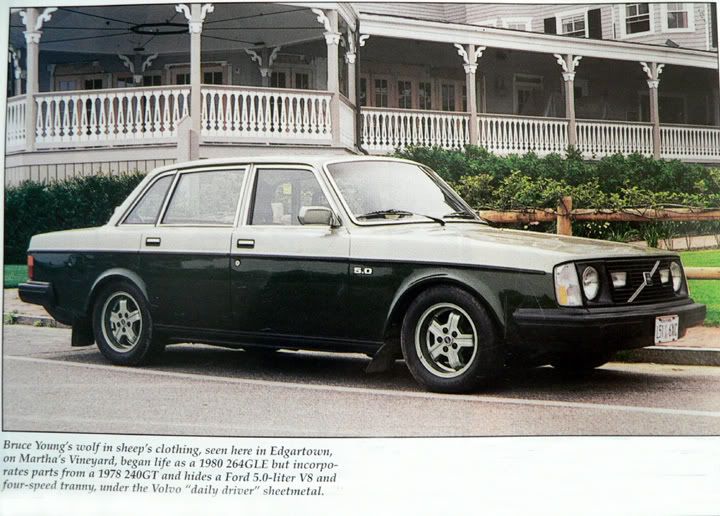
Bruce Young, '93 940-NA (current), 240s (one V8), 140s, 122s, since '63.
|
|
|
|
|
1. Look in the archives.
2. Sometimes it's in the power-door-lock wiring in the driver's door
--
240 drivers / parts cars - JH, Ohio
|
|
|
|
|
How many miles on the car? Check that the harmonic balancer is intact and not slipping.
|
|
|
|
|
You have written that you have 14.5 volts just idling (that's good), and 14.1 volts with the headlights, fan and wipers (that's good, too) -- all assuming that's when you first start up the car when it's cold. So you will have to ask yourself, what is different about the state of the car when you're sitting and idling, and taking measurements of the battery voltage, compared to when you're driving for 10-15 miles after which you find the battery has run down. By the way, you didn't say how low the voltage dropped after that time.
I should point out at this early point in our discussion that it is perfectly normal(!), even necessary, for the battery voltage to drop somewhat -- down to, say, 13 volts or so depending on your climate and the season -- after driving around a while. This is because the charging voltage is temperature dependent: when the battery is cold, the charging voltage is higher -- if you were in Buffalo, NY, right now (viz., polar vortex), your charging voltage should be nearly 15 volts when you first start up. And when warmed up (in the then toasty engine compartment) the charging voltage must be less in order to avoid overcharging and boiling the acid solution in the battery -- less than 13 volts would be normal driving in Arizona in the summertime.
I'll assume, however, that your concern, writing this post, is because your battery is draining to far lower voltages, under 12 volts, right? If so, you may have some component that's taking a big drain from your battery...
To start, when checking for a drain, measuring volts is of little value -- it just measures the state of the battery, and with the engine running, the alternator overwhelms and masks any sign of an abnormal drain. So while voltage is of little value (largely determining only whether the charging system is working), what you really need to do determine whether or not large amounts of energy is being drained somewhere. By the way, the test light is also of little value except to determine whether a wire is live or not; I don't know what you tried to measure with the test light connected to the negative cable, since it shouldn't light up (being grounded at both ends).
You need to, instead, set your meter to amps to measure current when you're trying to find a drain. With the engine TURNED OFF (!), you set your meter, measuring amps, on the higher scales (you can work down to lower scales when you made preliminary measurements) with probes between the negative cable clamp and the negative battery post: there should be (assuming only OEM accessories, meaning no aftermarket radio, etc.) only be about 12 milliamps (for the radio presets and ECU memory), with brief pulses to 25 ma for the clock stepper motor. Anything significantly more than that, and you may have a noteworthy drain.
Report back, and we'll go from there.
Good luck.
|
|
|
|
|
STAY TUNE WILL TRY WHAT YOU SUGGESTED TOMORROW. WHAT DO YOU CALL A BIG DRAIN?? ALSO AFTER THE 10 KMILE TRIP THE VOLTAGE GOES DOWN TO THE 9 VOLT RANGE BEFORE THE ENGINE SHUT OFF.;
|
|
|
|
|
One more possibility -- I only mention this because you wrote that you recently replaced your alternator.
There is a cable bundle that runs from behind the alternator and then snakes under the alternator mount -- it has the very heavy, main output cable (B+), and two smaller gauge cables (oil pressoswitch and alternator field wires), as well as the heavy ground.
Sometimes, when a new alternator is installed and rotated to fit the belts on the pulley, if that bundle isn't positioned just right, it gets pinched or crushed between the alternator and its mount, and (depending on which wires in the bundle are damaged) this could lead to a short. There's a possibility that a slight contact across the wires, resulting in a short, might be affected by the temperature of the engine compartment, or that even vibration (following a long drive) could affect their contact and therefore the flow of current through this short.
I know this is a long shot, but if you can't find anything else, consider this. By the way, a short such as this, depending on which wires in the bundle are involved, could burn through the oil pressoswitch and cause an oil leak (under pressure), and can even start a small fire burning the insulation (and using the typical oil sludge coating the area as fuel).
|
|
|
|
|
YES THIS WAS THE ORIGINAL PROBLEM, WILL CHANGE BATT,INSPECT WRING EVEN CHANGE BELTS,CHECK DOOR ATER WORK. STAY TUNED. THANK EVERYONE
|
|
|
|
|
Nine volts?! That is serious! I'm surprised the engine still ran at that voltage, viz. the requirements of the ECU and stuff.
What's hard to fathom is that I can't think of what could drain your battery when you're driving it, and wouldn't drain it when you're just sitting and letting it idle. So I'm thinking that it isn't a matter something creating a serious drain on the battery, but rather what is happening to the charging system after having driven the car for a while.
You wrote, if I recall, 20 to 30 miles. Is that about a half-hour or so of driving (highway, or secondary roads)? Have you just tried to let the car idle, stationary, for that same length of time (and with whatever accessories you used when driving such as your headlights), to see if the battery voltage declines similarly?
Sometimes, as the engine compartment warms up, the alternator belts' tensions might change (if it wasn't tight enough) and start slipping (you don't always hear a squeal when it slips). Thus, you've got a good charge when you start up, but it doesn't maintain it later when warm.
Similarly, there are bushings supporting the alternator -- 3 of them, actually, two on the shaft around which the alternator rotates (for adjustment), and another one supporting the end of the alternator's adjustment bracket (near the water pump). These age and go soft, and maybe flex too much when warm, affecting the belt tension.
Also, rpm can affect belt slippage. At idle, the belts might be okay, but when the rpm is higher (when driving the car at speed), they may start to slip and fall behind enough to fail to keep the battery charged.
Another possibility is some defect in the alternator, similarly temperature dependent. You did say that you got a new Bosch alternator -- was it really new, or rebuilt/reconditioned? The voltage regulator is supposed to change the voltage with temperature, but maybe it's cutting the voltage too much. Did you have this problem before you replaced the alternator (i.e., is it the reason you got the replacement), or is this problem new with this new alternator?
Also, any idiot lights glowing (even faintly)? If so, that could be a sign of worn brushes. They may be more troublesome when hot.
Report back.
|
|
|
|
|
"...Also, rpm can affect belt slippage. At idle, the belts might be okay, but when the rpm is higher (when driving the car at speed), they may start to slip..."
I had that very situation once. The alternator was spinning but not nearly fast enough. The belt was slipping but with NO squealing. It was late at night and the only way the fuel pump etc would keep running was to turn off the headlights (parking lights and tail lights on) and tailgate the car in front of me into the next town.
What happens to your voltage measurement when you really load up the electrical system - headlights on high beam, heater blower on high, rear windscreen demist on, radio, etc.? What does it do when you rev the RPMs under these conditions?
|
|
|
|
|
I would try another battery
|
|
|
|
|
Trying another battery can't hurt (if you don't have to buy one).
But it's unusual for even a bad battery, charged up (14.5 volts) at the start and assuming a good charging system, to lose voltage while the engine has been running. I'm interpreting the O.P.'s initial post to mean that the voltage dropped while the engine was running and supposedly keeping the battery, even a bad one, charged. Usually, a bad battery loses its charge after the engine is shut off (e.g., it can't restart the engine).
And I also interpret his post to mean that this keeps happening. If a battery was really that bad, it might do this one time, but if he can repeat this scenario over and over, that means that the battery charges back up to 14.5 volts each time he tries to repeat this.
But, as your suggested and as I wrote, it can't hurt to try another battery.
|
|
|
|
|


