|
|
|
Just had a rear axle bearing fail very completely with no warning. Heard a little thunk, then a sound like the parking brake shoes had lost their lining and jammed in the drum, except the cyclic grinding was at a lower frequency than the wheel RPM. What could it be? I figured the only thing going slower than the wheels is the bearing roller retainer cage.
Pulled it apart last night, and sure enough, retainer had completely failed. No piece longer than an inch. Pretty scary. Just got back from a 600 mile trip 180 miles ago. Would have been a show stopper. Fortunately, I have a spare kit "in stock" (gets that way with three 240's to look after).
Anyhow. Just briefly tried pressing the bearing off last night with my 15 ton Atlas and a good OTC bearing splitter. Seemed like it was taking a bit more force than it should. Getting late, so I said heck with it, I'll do it tomorrow when I won't rush and screw something up.
So I figured I'd tune into the forum today just to see if there were any helpful pointers on the job.
Whoa. What's all this about a bearing retainer ring? Saw reference to it for an '81, '83, and '91. Don't know about '81 and '83, but I'm pretty sure the '91 has my rear axle.
I vaguely recall some mention of a retaining clip or ring when I was reading my manuals anticipating my problem might be the bearing. Pretty sure neither my Volvo green book or my Bentleys mention anything about a retainer ring that has to be drilled or cut off. Did a quick reread last night when it seemed it was taking a little to much oomph. They both say press the old one off and the new one on, with about that much detail (the Bentleys, as usual is a little more forthcoming, and about one tenth the price. Damned Volvo...).
Now, obviously, there is the ring up against the bearing inner race that I assume the seal uses as a sealing surface. I figured it would have to be pressed off. Maybe even heated, after my abortive attempt at pressing, but drilled and/or cut?
Briefly looked in the repair kit earlier, but I can't remember if it had a new one of these rings, and it's at home while I'm at work, so no looking at it now.
Got to go to the dealership tonight to pick up lower ball joints for the old Mercedes, right out of work and twenty miles in the opposite direction to home. They do Volvo too, so I'll see about that ring then. Hope this ain't going to be one of those wrench in the works type deals because the Volvo is thoroughly disabled right where I planned on overhauling the Merc's front end in the comfy heated garage this weekend, with 80% chance of rain at 40° for tomorrow (Michigan's idea of spring. Just thankful it's not snow, like last weekend).
I'd welcome a little input on this retainer rumor.
Chuck
|
|
|
|
|
Follow Up On the Bearing Replacement
Well. That was kind of anti-climatic.
Being aware that things are a bit hard to press off, I moved the bearing splitter up to the "spacer", or "retaining ring". Put a fair bit of pressure on the handle of the Atlas and gave the top of the ram a solid whap (with my odd heavy double faced Estwing I found in a telephone booth about twenty years ago and have never seen another), just to get things moving, which they did.
Got a deeper bite with the splitter as soon as I had a little room. Still worried about putting too much pressure on it, both because I don't want to shell out the bucks for a new one and because I don't want to share a confined space with an OTC splitter that has received enough abuse to come apart.
The retainer was on there pretty firmly, I grant you, but it came off without much argument and no damage.
The inner race needed a little more persuasion. Put the torch to it, with a modest tip, for maybe 30 - 45 seconds each in the two places available between the jaws of the splitter. The splitter had a pretty good bite on the race so I felt free to bounce lightly on the press handle. The race cracked loose and moved fairly easily once it was started.
The new bearing went on quite easy, with light lube on the axle just to be sure nothing galled. The retainer impressed me. Lubed the axle again, but it still took notable force to push that bugger on. Didn't try a file on it, but it must be fairly hard and damned tough. Don't need to worry about the axle falling off with that retainer on the job!
Anyhow. Just getting in another view on rear axle bearing jobs. The only reason I can imagine for not pressing bearing and retainer off is if you don't have access to a press. But then, how would you put the stuff back on?
Chuck
|
|
|
|
|
Such a failure is not common. Perhaps a "lazy man's way" would work for you. Get a couple of shafts (surely one will be OK) from a JunkYard and swap in the whole thing.
Good Luck either way,
Bob
:>)
|
|
|
|
|
That's reassuring Bob. Got three of these little devils in the stable and I don't like failures with no warning.
Although, now that I think about it, I've had a light low frequency rumble for the last year at mid speeds. Not sensitive to throttle. Figured it was the center bearing and planned to replace it even though it felt fine when I replaced the front U-joint, attempting to cure the rumble. Didn't. So maybe I did get a warning? That'll be interesting to see.
Regardless, the other side will get replaced as a preventive measure since this is the car we use for traveling in the winter. Don't need any surprises on this level a couple thousand miles from home. I hate having to pay people to work on my car, even more than I hate letting them work on my car.
|
|
|
|
|
Just did the rear wheel bearings on my '82 245 last night. As far as the axle shaft wheel bearings go, I believe your 240 rear end would be the same as mine. (But, yours would have a speedometer sensor at the rear of the differential, where mine does not.) While I could hear mine, they had not actually failed before I got a chance to replace them.
I used an earlier suggestion from the Brickboard and cut mine off with a Dremel tool and cut-off wheels. Worked fine. I cut most--but not all--the way through the lock ring and the inner bearing race, after removing the bearing cage, then split both with a few sharp hammer blows on a sharp chisel right at the opening I'd made with the cut-off wheels. Split right off with no damage to the axle shaft. Then I cleaned up and deburred the inside of the two items I'd split and used them to help align and drive the new bearings and lock rings into place. I deburred them to minimize the chance of damage to the axle shaft while pressing on the new pieces. The lock rings is important for two reasons: 1) It holds the bearing in place--thereby keeping the axle attached to the car, and 2) The sealing face of the inner seal, which separates the bearing and its grease from the gear lubricant of the differential, rides on the surface of the lock ring. You want to avoid any damage to the face of the lock ring so that that seal can do what needs to be done.
Pressed the new ones on--unheated--using a pretty large shop press in two passes, first the bearing then the lock ring. Don't forget to make sure the retaining plate is in place before you start to install the new parts.
Best of luck.
|
|
|
|
|
Thanks for the info rusteebrick.
One question. Why did you cut the lock ring and inner race instead of just pressing them off? Granted, the "just" part is mainly faith at this point since, like I said, I temporarily abandoned the effort last night (and got back from the dealership with my box of goodies too late to get at it tonight).
While at the dealership I took a look at their drawing of what's in the bearing kit and it said it includes a lock ring. Whew! Took another look in the box when I got home. Mine doesn't have a lock ring. It's got a damned Volvo muffler hanger. What the...? I don't know. Maybe I put it in there. Bottom line is I don't have a replacement lock ring, so the existing one has to do it.
My plan at this point, unless I get some feedback otherwise, is to heat the lock ring and push it off, then heat the inner race, which is all that's left on the axle, and push it off. I'll cut the race if I have to, but I find it hard to imagine heating it up good won't turn the trick.
|
|
|
|
|
Glad your fix is done! In answer to your question about my cutting off the lock ring and inner race: I did so because my shot at the press would be limited, I wasn't sure a bearing splitter would be available, and I could do the preparatory cutting at my leisure. I also wanted to have a close look at the shaft surface for thorough cleanup before I got to the press and was short of time. In short, cutting rather than pressing them off was more a matter of convenience and preference, rather than any mechanical advantage.
Best of luck.
|
|
|
|
Why did you cut the lock ring and inner race instead of just pressing them off?
I believe the combined resistance of both is more than the average press can overcome.
Bottom line is I don't have a replacement lock ring, so the existing one has to do it.
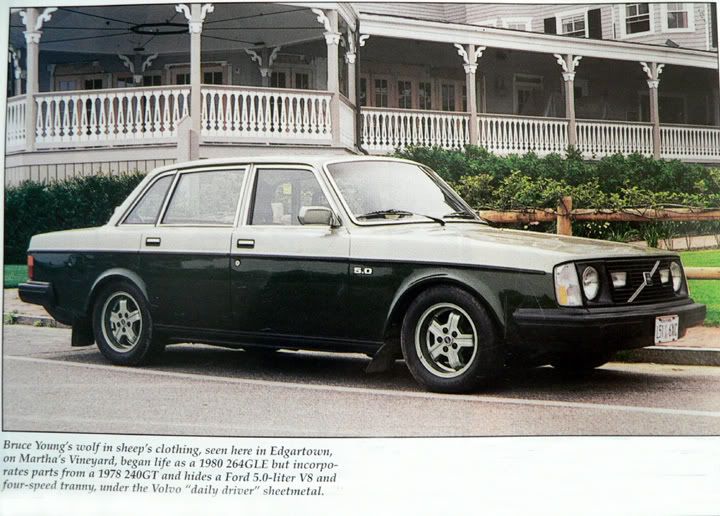
Replacement locking rings (were) are available. Volvo # 383168. May be listed as a "spacer", but believe me, it locks. I haven't done one since 140 days (same as 240), but drilling and splitting is the only way to go, IMO.
--
Bruce Young
'93 940-NA (current) — 240s (one V8) — 140s — 122s — since '63.
|
|
|
|
|
Hi again Bruce,
I've moved on from weird brake problems to more conventional stuff, although I'm beginning to doubt if the term conventional can be made to apply to anything related to Volvos. Those Swedes do some strange engineering, and I'm a Swede.
Thanks for the info, but it sounds like just the nasty sort of feedback I was fearing. Hmm. Well. Maybe I can put the whole thing together without the lock ring just to get it out of the garage for the weekend. Then order up the lock ring and pull the axle again and press the damned ring on. Grease should still be good if I don't drive it. It looks like a shot inner seal may have been the predecessor to the bearing croaking in this instance. Washed all the grease out but didn't provide enough gear lube to compensate.
I was a little concerned about tempering the original "spacer" (yah, that's what they call it. Sounds innocuous) by heating it up anyhow. No sweat to hack it off. My line of work revolves around aircraft turbine engine alloys, so I've got some pretty mean spirited little abrasive disks that laugh at anything shy of stellite, as long as you keep the RPM up.
Well, thanks again. Hmm...
|
|
|
|
|


